
Menu
Menu
En cours
A Venir
Billetterie
Collections en ligne
Actualités
Boutique
Restaurants et privatisation
From 23 September 2026 to 17 January 2027, the Grand Palais co-produced « Cezanne and us » with the Centre Pompidou and the Public Establishment of the Musée d’Orsay and the Musée de l’Orangerie – Valéry Giscard d’Estaing.
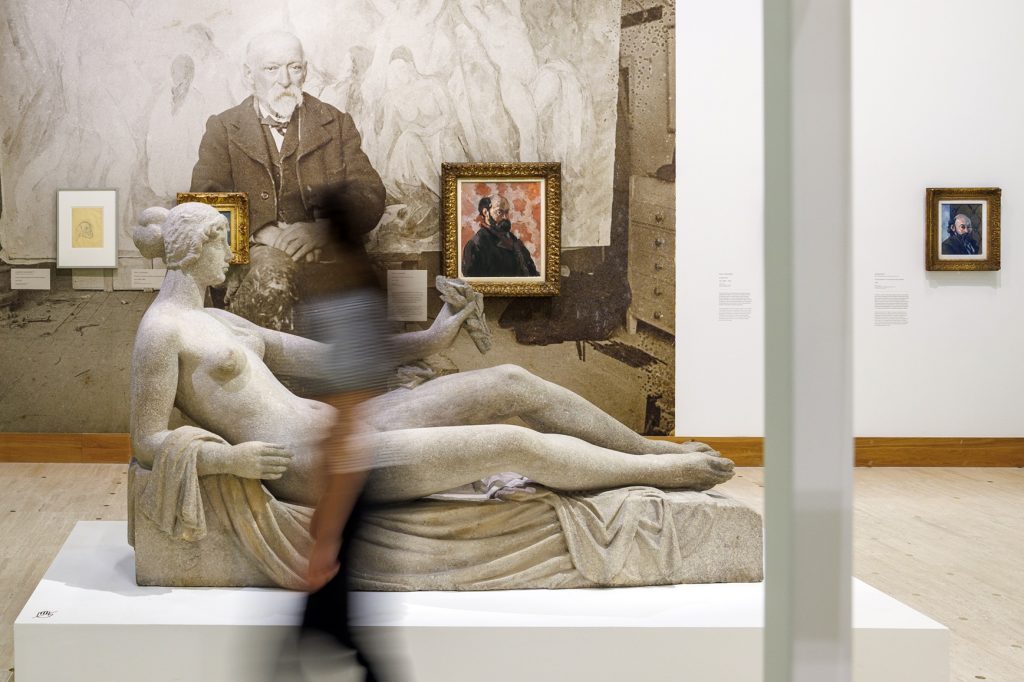
Cezanne and us at the Grand Palais
With « Cezanne and us », the Grand Palais proposes to trace, for the first time in its entirety, the posterity of the work of Paul Cezanne (1839-1906), from the 1880s to the present day. It compares the achievements of the painter with those of artists who, over generations, have recognized him as a founding figure. By bringing together the collections of the Musée d’Orsay, the Orangerie and the Centre Pompidou, as well as works from foreign funds, « Cezanne and us » allows us to measure the richness of the legacy of the painter of the Sainte-Victoire.
Long marginalized by institutions, Cezanne gradually established himself as one of the major figures of Western modernity, to the point of being considered by Picasso as “our father to all”. This idea of filiation finds a particular echo in the title of the exhibition, « Cezanne and us », designating as much the generations of artists who have claimed his work as the view we take today on the painter from Aix. From his first admirers to the birth of the avant-gardes, then to the different currents of abstraction and contemporary artistic practices, his work has been constantly reviewed and reinvested.
About the « Monument à Cezanne » by Aristide Maillol
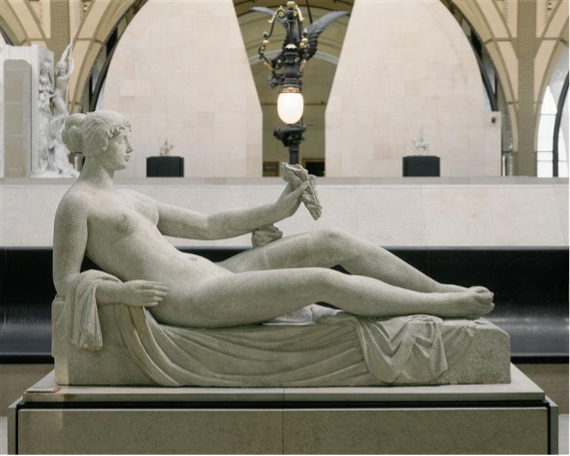 Aristide Maillol, Monument to Cezanne, between 1912 and 1925, pink marble of the Canigou, 140 x 227 x 77 cm, weight: 1610 kg, RMN Grand Palais (Musée d’Orsay), Paris. © Hervé Lewandowksi.
« Perhaps no work has cost so much labor, nor caused Maillol more concern. »
– According to Pierre Camo, Maillol my friend, 1950
Designed in honor of Paul Cezanne by Aristide Maillol (1861-1944), this monument bears witness to the singular place that the painter occupies in the history of modern art. The whole of Cezanne’s work exerts a considerable influence on the generations that follow him. Presented in the « Homage to Cezanne » section of the exhibition, sculpture occupies a singular place at the center of the room.
At the death of Paul Cezanne on 22 October 1906, the project to erect a statue commemorating the painter was quickly born in his hometown, Aix-en-Provence. The initiative goes to his merchant, Ambroise Vollard, who formulated the idea in June 1907. The committee, chaired by Frantz Jourdain, president of the Salon d’Automne, collects donations and organizes a sale of works of art generously donated by their authors. The choice of Aristide Maillol (1861-1944) soon became necessary to ensure its realization. For the sculptor, this project has a special significance: it offers him the opportunity to pay tribute to an artist he considers as « the genius of modern painting » . The commission is part of a moment when Cezanne’s recognition is gradually gaining momentum. The paintings of the latter become an essential reference for artists who seek to renew the forms and language of painting. The commission of the sculptural tribute should thus symbolize the moment when crystallizes Cezanne’s status as a tutelary figure of modernity.
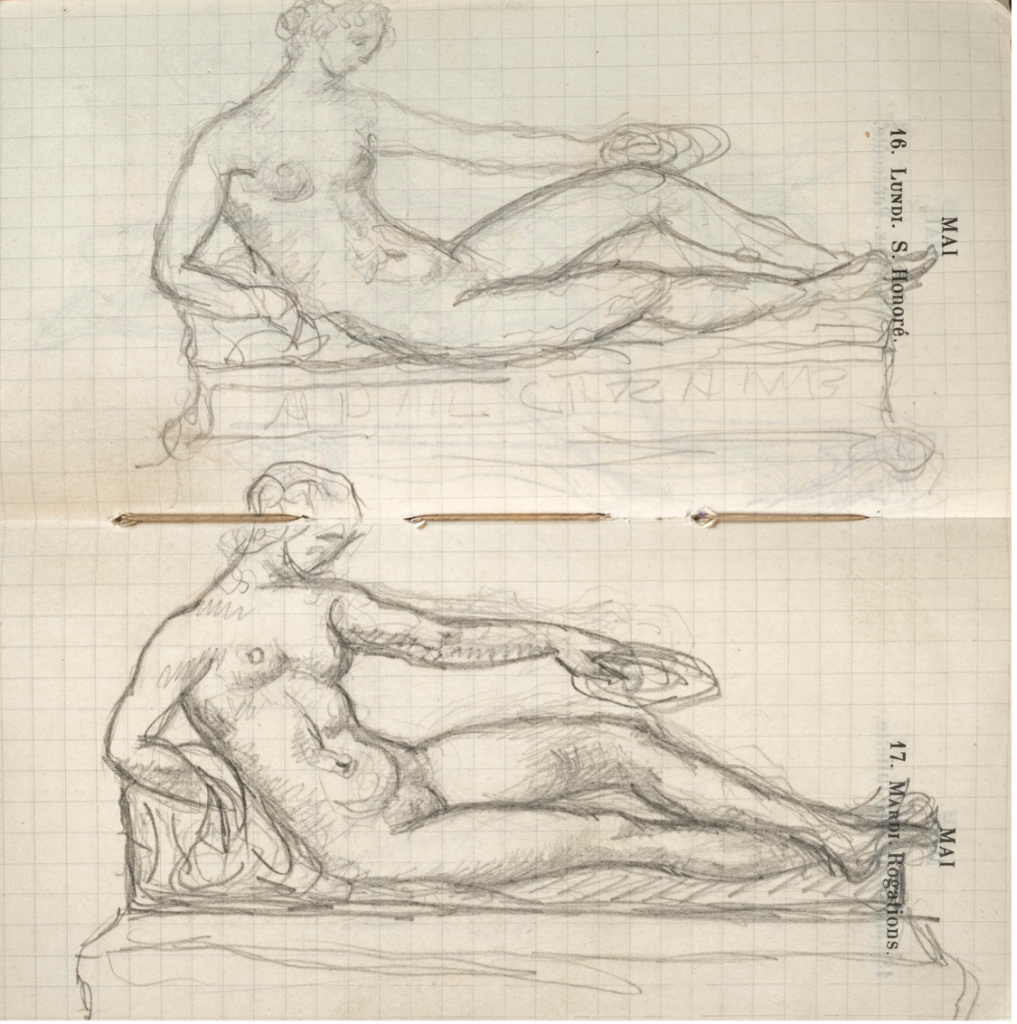 Aristide Maillol, study for Monument to Cezanne, lead mine, study book, 1912, Dina Vierny Foundation – Musée Maillol.
Maillol renounces the traditional representation of the artist’s portrait and substitutes it with an allegorical figure, that of a long nymph holding in his hand a laurel palm. By this gesture, she symbolically offers the honors to the memory of the painter. The pose, immediately considered by the statuary, is the subject of numerous studies intended to specify the movement of the legs and arms or the treatment of the drape. This approach is in line with his conception of sculpture, based on the search for essential forms and the simplification of lines and plans. Maillol recognizes in Cezanne an ability to go beyond the simple representation of reality. Both try, by different means, to reach a simple and universal form.
« I always start with the whole. At first, my idea is vague. It’s by working on it that it becomes visible (…) I try to stay in the simplest data, like lines and plans. It’s not easy : nature is mobile and changing. »
– Aristide Maillol
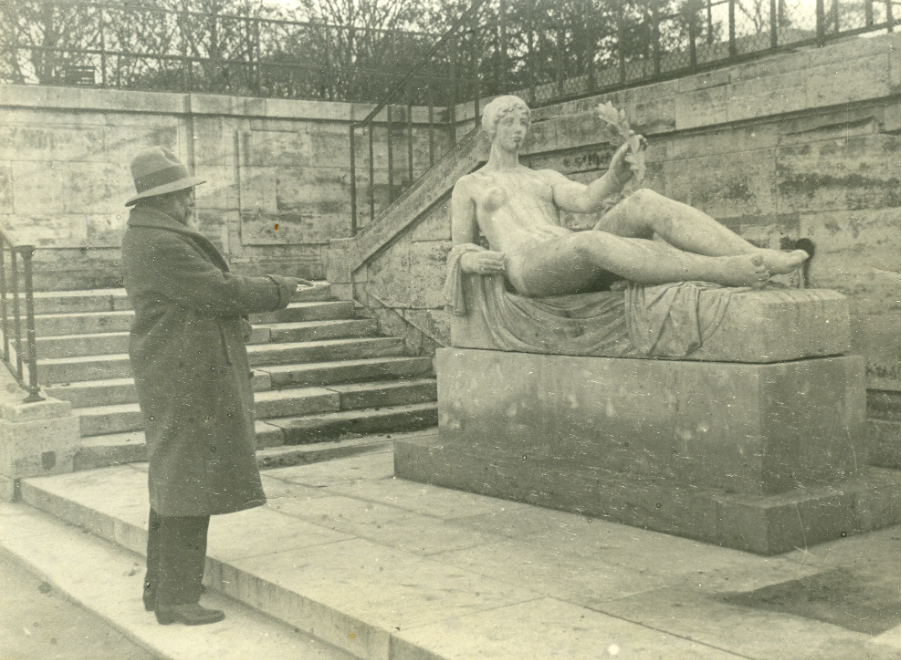 Unknown photographer, A man standing in front of the Monument à Cezanne installed in the Tuileries garden in Paris, undated, archives of the Dina Vierny Foundation – Musée Maillol.
Replacing the traditional portrait with an allegorical figure was a choice that was difficult to accept. First refused by the City of Aix-en-Provence, which considered it inappropriate to pay tribute to the master in the form of a female and naked body, the first state of the Monument à Cezanne finally experienced a completely different destiny.
Acquired by the State, the Monument à Cezanne became the first stone sculpture by Maillol to be placed in the middle of the staircase on the side of the Orangerie, in the Tuileries garden, thus consecrating the recognition of the monument in public space. Its installation on a deliberately low base is of particular importance for the sculptor, who is anxious to place his works at human height and thus promote a more direct relationship between the nymph and the viewer’s gaze.
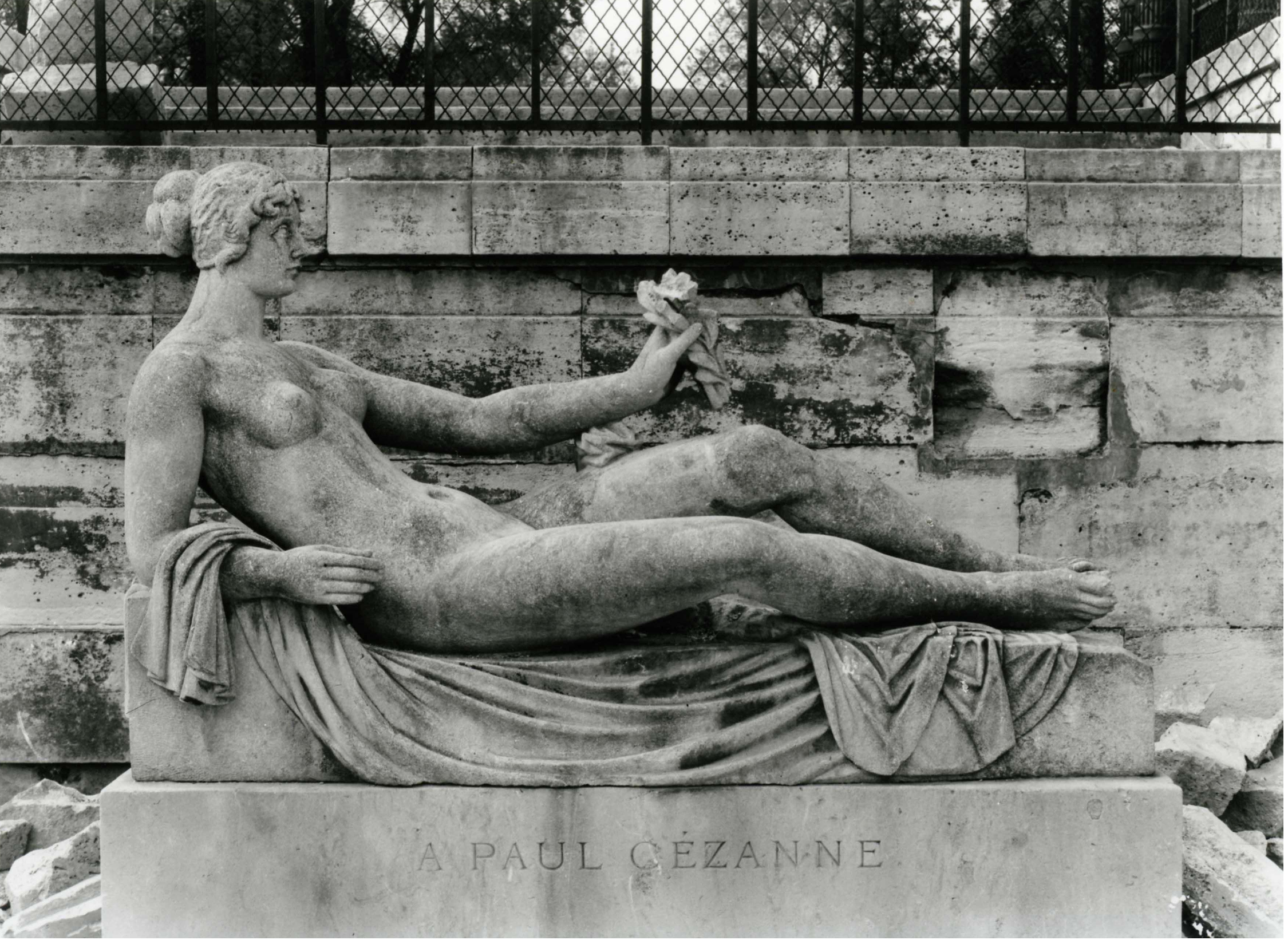 Walter Drayer, Monument to Paul Cezanne in the Tuileries garden, undated, Paris, Fondation Dina Vierny – Musée Maillol.
Fragile and porous, the pink marble, in which the sculpture was made, does not withstand the passage of time and gradually deteriorates. In 1963, the Hommage à Cezanne was removed from the Tuileries, with La Méditerranée en marbre, another production by Maillol installed in the garden. The two statues join the collections of the National Museum of Modern Art, before being transferred to the Musée d’Orsay. Dina Vierny then asked André Malraux, Minister of Cultural Affairs, to replace them with lead cast irons.
Malraux proposes to dedicate the garden of the Carrousel to the sculptural creations of Maillol. The project took on a broader dimension with the installation of eighteen monumental bronze and lead sculptures, which were installed there from 1964 under the direction of Dina Vierny, giving rise to a true « open-air Maillol museum ».
Aristide Maillol sees in Paul Cezanne a major figure in modern painting. By paying homage to him, he seeks to translate into sculpture the growing recognition that Cezanne received at the beginning of the 20th century. The destiny of the monument goes beyond this primary intention, however, since its presence in the gardens of the Carrousel also contributes to permanently inscribing Maillol’s work in public space.